Trump Make America Great Again Service Mark
Fifty-fifty equally Donald Trump stumps for votes and kisses babies on the trail of the US presidential campaign, he's clearly all the same a businessman at heart. And that means leaving no neat (and potentially valuable) slogan un-trademarked.
In July, simply a few weeks after he announced he was seeking the Republican nomination, he obtained a trademark for the campaign slogan "Make America Great Again". Trump had applied for the mark all the way back in November 2012, immediately subsequently Mitt Romney lost the election to Barack Obama.
The registration covers election-related services such as "promoting public awareness of political bug". Nonetheless, last August Trump filed another trademark application for the same slogan in connectedness with the right to put information technology on all fashion of clothing from T-shirts to tank tops and hats.
Since the presidential candidate started wearing his blood-red hat bearing the slogan, the production has become a must-take amongst his supporters. Information technology can be bought in unlike colours for United states$25 on official Trump-related websites.
Trump's fans have, however, recently been offered alternative – and unauthorised – products. Replica versions of the hats bearing Trump's slogan are sold by many for as piddling as Usa$4.99. And the tycoon-turned-politician has not waited long to protect his trademark and is currently going later the people backside these knock-offs.
1 such seller is CafePress, a well-known popular website that allows its customers to print their own designs on T-shirts, coffee mugs and other products. Trump's lawyer sent the company a warning letter only a few days agone, asking it to end infringing the registered trademark.
But can you actually trademark a slogan? And is it wise for a candidate request for votes to also demand they pay up to don hats and shirts that bear it?
Distinctive not descriptive
Slogans are important elements in advertising campaigns as brand owners promise that consumers will link them with their products and services, besides as their main brand.
A number of attempts have been made in the past to register slogans as trademarks. But these attempts have frequently been unsuccessful and registrations accept been refused because the slogans in question were devoid of distinctive grapheme (distinctiveness is the main requirement to register all categories of signs).
Indeed, boilerplate consumers are often not in the habit of making assumptions about the origin of products on the basis of slogans, equally they consider them as simply advert letters and therefore merely advisory, generic or laudatory.
For case, slogans such equally "Proudly Made in the USA" (in connectedness with electrical shavers) and "America's Freshest Ice Foam" (in relation to ice creams) were held unregistrable in the U.s. for being merely descriptive and then indistinguishable from other similar products.
When US multinational All-time Purchase tried to register the phrase "best buy" when written on price tags, an EU Court deemed it devoid of any distinctive character and refused the registration. Similarly, when Citigroup tried to trademark the slogan "Live richly" the court rejected it, as it was deemed that European consumers were perceive the phrase simply every bit promotional formula.
In lodge to overcome such objections, brand owners accept to prove that the slogan they want to protect has acquired a "secondary meaning" on its own. A slogan is thought to have acquired such meaning if the brand possessor tin can demonstrate that its use past another political party would cause defoliation amongst consumers as to the producer or provider of the goods or services. Famous examples of this category of slogans are KFC'southward "Finger Lickin' Skillful" and Nike's "Just Do Information technology".
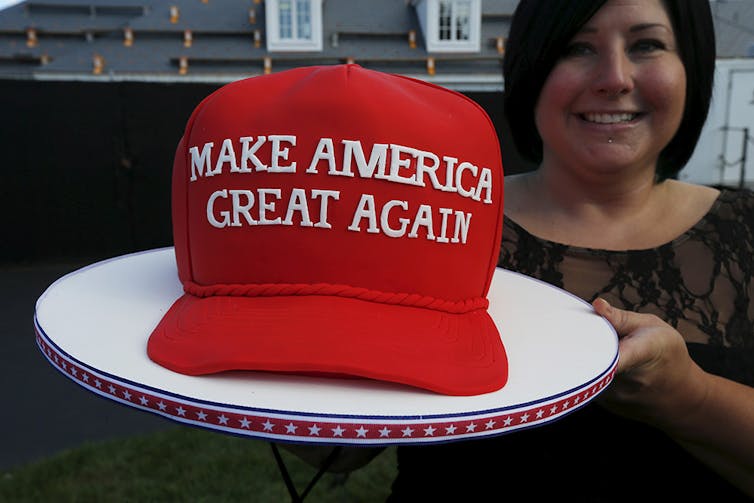
Does 'Brand America Great Once again' fit the bill?
Despite successfully registering "Brand American Great Again", Donald Trump may need to take on objections that his slogan is just descriptive and laudatory. Trademarks may be revoked even after registration, if judges or trademark offices later on concord they exercise non meet requirements for protection and should have never been registered.
He might likewise exist unable to prove that "Brand America Great Again" has acquired a secondary meaning to move it beyond "descriptive" status. The slogan has been a common campaign catchphrase used in the past by several Us politicians. Ronald Reagan start used information technology in his 1980 presidential campaign, and many people in the US still link it to his political era. Ted Cruz and Scott Walker, other candidates for the upcoming election in 2016, accept likewise used it.
Whether or not Trump's legal motility is compliant with trademark police and despite his making certain he doesn't need further coin to finance his self-funded campaign, information technology however seems an opportunistic way to get profits by using politics and to take economic advantages from his own supporters.
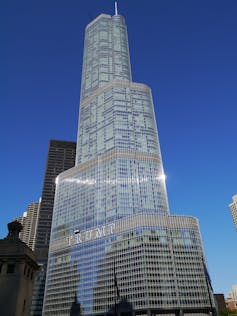
This does non come up as a big surprise. Donald Trump knows how to create and strengthen a brand, as he has done (and is still doing), spending lots of money licensing out his name on products and services that include ties, perfumes, water and of course hotels.
But when it comes to politics, which entails request people to vote for yous and then adopting policies in the pursuit of the public interest, it sounds odd and ethically dubious to mix the latter with profit-seeking.
Source: https://theconversation.com/how-donald-trump-trademarked-the-slogan-make-america-great-again-49070
0 Response to "Trump Make America Great Again Service Mark"
Post a Comment