Macbook Pro Folder Says Waiting to Upload
iCloud is ane of those features in macOS which works about all the time for the slap-up majority of users, but is vulnerable to problems when Apple makes changes to it, typically in a major new version of macOS. But a few years agone, changes which had already been appear had to be cancelled early on in beta-testing because of the devastation they caused to existing iCloud accounts. Thankfully the changes to iCloud in Monterey are relatively minor, but take still caused plenty of users to complain of syncs that seem never to end, and other issues. This commodity aims to provide a little understanding, and peradventure even assistance you to a solution.
How iCloud works
iCloud is a vast distributed database, in which each user's data and files are merely a few of its contents. And then when you put a file into iCloud Drive, what your Mac does is negotiate that with the database server, which then stores the file equally a record containing its data and metadata.
On your Mac, files in iCloud Drive exist in one of 2 states: a local and complete copy, which is kept in sync with that held in iCloud, or a stub file which relies entirely on downloading the file contents from iCloud when you lot want to access it. The first of those has been downloaded, and the 2nd has been evicted from local storage. Those tin can be told apart in the Finder and elsewhere using standard icons: that showing a cloud with a downwardly arrow ways that detail has been evicted, and the file shown in the Finder is just a stub.
Usually, unless you enable Optimise Mac Storage in the iCloud section of the Apple ID pane, the contents of your iCloud Bulldoze are kept in a downloaded state, ensuring that you can utilize them immediately. Enabling optimisation lets macOS manage whether each item is downloaded or evicted. In theory, provided in that location's sufficient local complimentary disk infinite, all recently active items should exist kept downloaded. When pressure on complimentary infinite grows, macOS will progressively evict your files until there are just folders full of stubs.
In practice, this distinction isn't always as clear. Some items all the same seem to become evicted even when optimisation isn't turned on, and with information technology enabled and ample local gratuitous storage, less used files however get evicted. I have two apps, Cirrus and Bailiff, which give you improve command over this. If you're going somewhere with poor Internet, for instance, y'all can use them to download all the files yous need earlier y'all go. They don't, though, guarantee that at the last infinitesimal macOS won't decide otherwise.
Desktop & Documents
There'south ane major decision you lot make about how iCloud Bulldoze works on your Mac, and that's whether to put your Desktop & Documents Folders in iCloud, controlled in the Options for iCloud Bulldoze in the Apple ID pane again.
When Apple offset released that, I nearly lost my unabridged Documents folder when it was sucked up into the cloud. As a event of the experiences of many users at that fourth dimension, I recommended that no i should even consider using it until it became more reliable, and potentially less destructive. It has since matured, merely tin all the same give ascent to serious problems.
The worst come when you lot accept ample iCloud storage and relatively footling in your Data book. It'south then easy to terminate upwardly with more files in iCloud than your Data book could ever store. That poses a problem, every bit you lot can only continue with many or most of those files evicted, and are unable to download them all. You are then a prisoner of iCloud, with documents that y'all can't shop locally. For this and other reasons, I still urge users not to enable Desktop & Documents unless their Documents folder is going to remain pocket-sized, perhaps past adding a local folder to their Domicile folder for locally stored documents merely, which defeats the purpose.
It's besides the case that those Macs with Desktop & Documents enabled are well-nigh likely to encounter problems when iCloud changes, for example with a new version of macOS. And because they're more dependent on iCloud, the impact of those problems is greater too.
Databases
Nigh other items listed in the iCloud section of Apple ID, from Contacts to Stocks, don't shop their information in simple files, but in databases. When your local apps sync with iCloud, database records are exchanged. You take substantially no command over those, other than whether to enable the service or not. Tracking file syncing with iCloud is complex enough using the log; you don't stand a take a chance of doing that with databases.
Check your Cyberspace connection
This has improved greatly in Monterey, with the add-on of a new command tool which is simple to apply and highly informative: networkQuality. To use this, open up Terminal, and type
networkQuality
After a pause for thought, you should see something like
==== SUMMARY ====
              Upload capacity: 554.709 Kbps
              Download capacity: 3.424 Mbps
              Upload flows: 20
              Download flows: twenty
              Responsiveness: Low (44 RPM)
This is explained in fuller detail by Dan Petrov, and is far more useful than just for the investigation of iCloud bug. And don't worry, I'm waiting for a major upgrade to my Net connexion.
Check the service
iCloud, like Apple's other services, doesn't work perfectly all the fourth dimension. Before going any farther, open Apple's service status page hither and check whether it might have a known problem.
Run a Cirrus sync exam
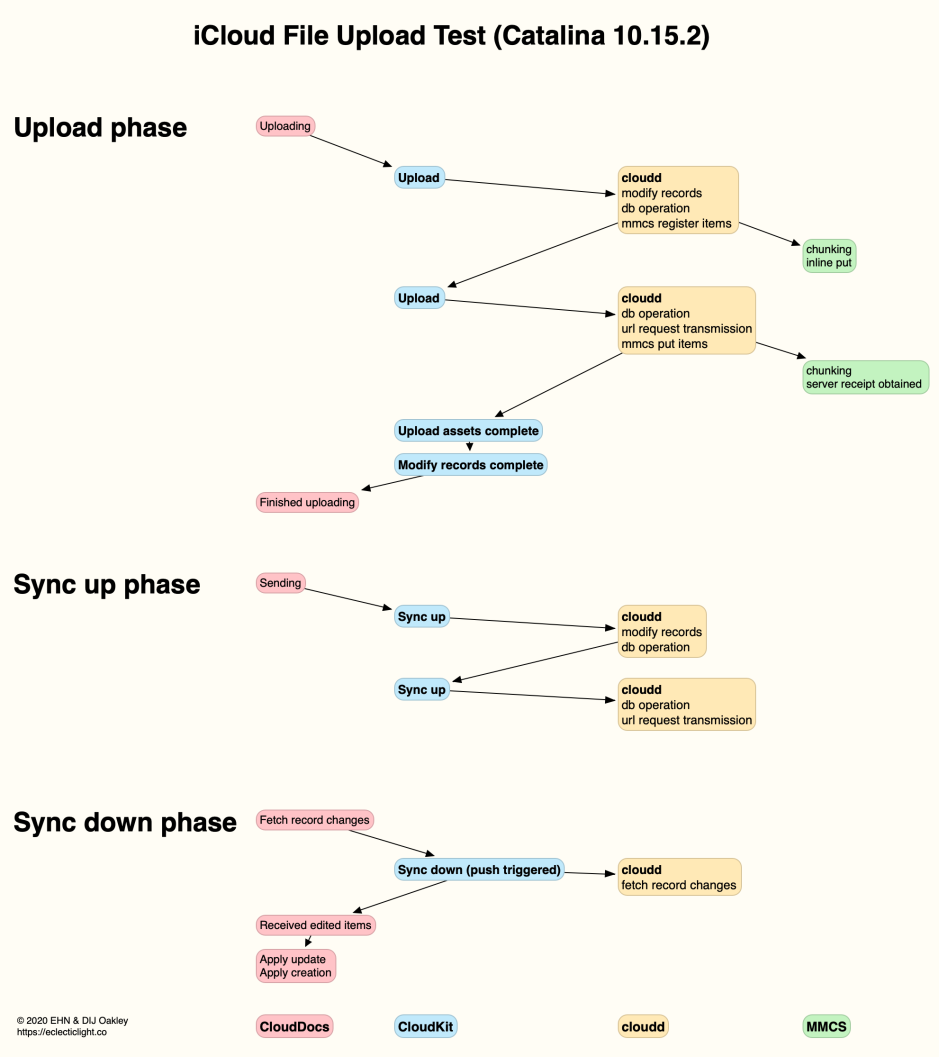
Cirrus offers a standard exam based not on a database sync merely on transferring one i MB file to iCloud Drive. Sometimes merely running this test can prove sufficient to kickstart iCloud syncing, only its chief purpose is to verify that iCloud sync is working. If you fancy going deeper, you can as well apply information technology to review what happens in the log during that procedure.
The beginning time that yous endeavour this, you lot'll find information technology best performed when everything else on your Mac is quiet, perhaps showtime affair in the morning before you've started any apps, and certainly before opening apps which utilise iCloud. Running the test is simple: equally your system clock reaches 00 seconds, press Command-1 in Cirrus, or release the Examination Upload command in the Window carte. Scout what happens with the iCloud sync circle in a Finder window, and notation the number of seconds when that icon fills and is removed.
If you want to examine that in the log, utilise the Open Log Window command in the Window menu, set the Get-go time to only earlier you initiated the test upload, and the Terminate fourth dimension to at least the time that iCloud sync completed, and no less than 10 seconds after (in High Sierra and before, 20 seconds). Finally click on the Become log button, and you're set to study what happened. To clean up the test files, apply the Clean Up Exam control in the Window menu.
Cirrus performs the test as follows:
- Information technology first writes a 1 MB file containing 0x88 bytes as information to ~/Library/Preferences/co.eclecticlight.Cirrus.data
- It then creates a URL to a new file co.eclecticlight.Cirrus.data in your iCloud Drive, at the path ~/Library/Mobile Documents/com~apple~CloudDocs/co.eclecticlight.Cirrus.data
- If that succeeds, it removes that new file and copies the 1 MB file from ~/Library/Preferences/co.eclecticlight.Cirrus.data into your iCloud Drive at ~/Library/Mobile Documents/com~apple~CloudDocs/co.eclecticlight.Cirrus.information
- If whatever step in that fails, Cirrus reports that it was unable to transfer the test file in an alert.
The Make clean Up Examination control just deletes the 2 files ~/Library/Preferences/co.eclecticlight.Cirrus.data and ~/Library/Mobile Documents/com~apple~CloudDocs/co.eclecticlight.Cirrus.data.
Fifty-fifty without going near the log, this is nevertheless useful every bit a test of basic iCloud Drive office. Y'all'll find a detailed account of the log extracts in this commodity.
Cirrus' Help book contains more information nigh how to employ Cirrus, and iCloud Drive more by and large.
Turn it off and back on
Having got this far, you're no dubiousness waiting for the secret technique which volition fix any remaining problems. I'1000 sorry to disappoint, but, apart from downloading or evicting items, the only control y'all take equally a user is the on-off switch: with individual iCloud services in the iCloud section of Apple ID, and signing out and back in using the Overview department.
Earlier y'all use any of those, ensure that you've downloaded all important documents, something Cirrus and Bailiff can assist with, and where necessary made local copies of those outside your iCloud Drive binder.
Each person who is reduced to trying this arrives at what they consider is the nearly effective solution. It might even be a matter of putting your Mac to ane side and letting it go on with it for a day or two, or signing out, shutting that Mac down overnight, then signing in again. All I tin can exercise is wish you lot every success. And if all else fails, then sometimes Apple tree Support tin can help.
Source: https://eclecticlight.co/2021/12/03/what-to-do-when-icloud-gets-stuck/
0 Response to "Macbook Pro Folder Says Waiting to Upload"
Post a Comment